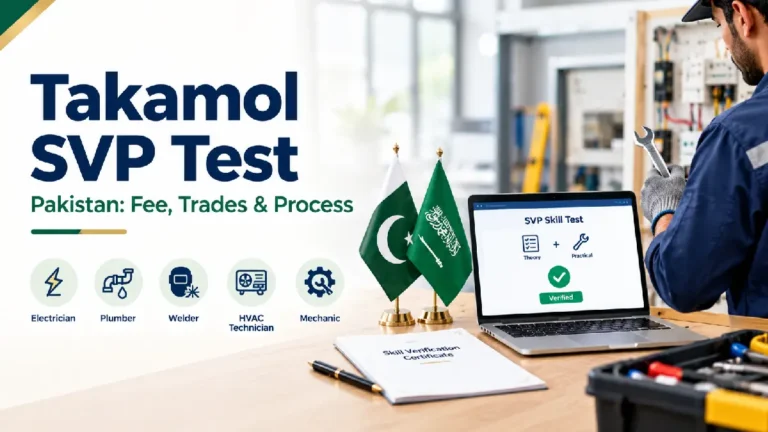
Takamol Skill Verification Program in Pakistan: The Complete SVP Test Guide
If you are a skilled worker heading to Saudi Arabia, there is a good chance you cannot get your work visa without passing a skills test in Pakistan first.
That test is the Skill Verification Program, usually called SVP or simply the Takamol test. It is run by Takamol on behalf of Saudi Arabia’s Ministry of Human Resources and Social Development, and NAVTTC is the implementing partner here in Pakistan.
This guide covers what the test is, who needs it, what it costs right now, how to register without getting overcharged, and why tradesmen with fifteen years on site still fail it.
| Key facts | Details |
|---|---|
| Full name | Skill Verification Program (SVP) |
| Run by | Takamol, for Saudi Arabia’s Ministry of Human Resources and Social Development |
| Partner in Pakistan | NAVTTC (National Vocational & Technical Training Commission) |
| Who needs it | Workers going to Saudi Arabia in occupations notified by Takamol |
| Assessment fee | USD 85 per test, roughly PKR 23,500 to 24,500, effective 9 September 2026 |
| Documents needed | Valid Pakistani passport and CNIC |
| Where you register | Directly on the Takamol SVP portal |
| Test format | Practical assessment, with a theory component in many trades |
| Result | Checked online; certificate carries a QR code |
| Retests | Permitted |
What the Takamol Skill Verification Program actually is
Saudi Arabia used to take a worker’s word, and his employer’s, that he could do the job. Too often the man who arrived could not.
SVP closes that gap. Before a skilled worker can be issued a Saudi work visa in a notified occupation, his competence has to be assessed and certified in his home country. Pass, and you hold a certificate Saudi employers and the visa system recognise. Fail, and the file stops there.
Who Takamol is
Takamol is the Saudi organisation that designs and runs the assessment. The curriculum, the test patterns, the assessment methodology and the compliance rules are all Takamol’s. Saudi Arabia decides what “competent” means for each trade, not Pakistan.
What NAVTTC does
NAVTTC is the implementing partner on the Pakistani side. It accredits the assessment centres, licenses the national assessors who conduct the practical evaluations, and connects the programme to Pakistan’s own vocational qualification framework.
In plain terms: Saudi Arabia sets the standard, Pakistan provides the centres and the assessors.
What SVP does not do
This is the single most misunderstood point, and it costs people money.
NAVTTC states plainly that Takamol provides skills assessment services only. It is not a training provider and not a job provider.
So:
- Nobody will teach you your trade on the way to the certificate.
- Passing the test does not give you a job offer.
- Passing makes you eligible for employment in Saudi Arabia, subject to all the normal visa and employment requirements.
Anyone promising you a job because you passed SVP is selling something else.
Who needs to take the SVP test
You need it if both of these are true:
- You are going to Saudi Arabia for work, and
- Your occupation is one that Takamol has notified as requiring skill verification.
It is not a blanket requirement for every Pakistani worker. General labour and many unskilled categories do not need it. Technical and skilled trades usually do.
Before you pay for anything, confirm that your exact job title is on the notified list. Paying for a test your category does not require is a common and avoidable waste.
Trades that commonly require verification
| Trade group | Typical occupations |
|---|---|
| Welding and fabrication | Welders, pipe fabricators, steel fixers, fitters |
| Electrical | Electricians, industrial and maintenance electricians |
| Plumbing and HVAC | Plumbers, pipefitters, HVAC technicians, refrigeration technicians |
| Construction trades | Masons, carpenters, plasterers, tile fixers |
| Heavy equipment | Excavator, crane, loader and forklift operators |
| Mechanical and automotive | Auto mechanics, diesel mechanics, machine operators, workshop fitters |
The list changes. Treat this as a guide to the kind of trade covered, and check the current notified occupations on the portal before booking.
What the test costs right now
Here is where most of the information online is simply out of date.
The assessment fee is USD 85 per test, roughly PKR 23,500 to 24,500 depending on the exchange rate. NAVTTC’s own page states this fee took effect on 9 September 2026.
You will still find many pages, some of them ranking well, quoting USD 50 or PKR 19,000. Those figures are from the old fee structure. If you budgeted on that basis, budget again.
Two more things worth knowing about the fee:
- It is per test. If you sit a second trade, or retake one, that is another fee.
- It is paid online through the SVP portal, not in cash to an agent.
Fees change, and they have changed recently. Check navttc.gov.pk/takamol for the current figure on the day you register rather than trusting any third-party page, including this one.
The appointment-booking trap
Search for the Takamol test and you will find a row of sites offering to “book your NAVTTC appointment online” for a fixed price. Many quote around PKR 19,000 to 20,000, payable through a mobile wallet or bank transfer.
Read the official position carefully: candidates register directly on the Takamol SVP portal and pay the assessment fee through the online payment system.
That means:
- You do not need a middleman to book an appointment.
- A “token” or “appointment slip” is generated by the system itself once you pay.
- Any amount above the official fee is a service charge going to a private company, not to NAVTTC or Takamol.
Some of these services are simply people charging to fill in a form for those who struggle online. That is a real service for some workers, and there is nothing illegal about it. But you should know what you are paying for, and you should never hand your original passport to one.
Before you pay anyone, ask them directly: what is the official fee, and what is your service charge on top? A straight answer is a good sign.
Documents you need
According to NAVTTC, only two documents are required for a Takamol test:
- A valid Pakistani passport
- Your CNIC
No experience letters, no trade certificates, no employer paperwork.
You will see other sources listing a demand letter or proof of trade experience as requirements. That may reflect what a particular agency asks for as part of its own process, or older rules. The official position is passport and CNIC.
Make sure the name and spelling on your passport and CNIC match exactly. A mismatch here will follow you through every later stage: the visa, the stamping, the Protector clearance and the ticket.
How to register, step by step
- Confirm your trade is notified. Check that skill verification applies to your exact occupation before spending anything.
- Create your account on the SVP portal. Enter your passport and CNIC details exactly as they appear on the documents.
- Select your trade. Choose carefully. Selecting the wrong trade means being assessed against the wrong standard, and the fee is not refunded for your mistake.
- Pay the assessment fee online. USD 85 per test through the portal’s payment system.
- Download your appointment slip. The system generates your appointment or roll-number slip once payment clears. Print it and keep a copy on your phone.
- Attend the assessment centre on your date, with your passport, CNIC and slip.
Rescheduling is possible in most cases but is limited. Do not book a date you already know you cannot attend.
What happens on test day
The assessment is competency-based. That means it measures whether you can do the work to a defined standard, not whether you have a certificate saying you once learned it.
Most trades involve:
- A practical assessment. You perform tasks from your trade while a licensed assessor scores you against the Takamol standard.
- A theory component. Many trades include a written or oral section covering standards, safety, tools, measurements and procedure.
Duration varies by trade. Welding assessments generally take longer than most. Tools and materials are normally provided by the centre.
Bring your own personal protective equipment if you have it. Safety behaviour is assessed, not just output.
Why experienced workers fail
This is the part nobody warns you about, and it is the reason a man with fifteen years on site can walk out with a fail.
The theory paper. Being able to weld is not the same as being able to answer written questions about symbols, tolerances and procedure. Many skilled workers have never been examined on paper in their lives.
Unfamiliarity with the format. If you have never been formally assessed, you do not know how long you have, what the assessor is scoring, or how marks are allocated.
Site habits versus the standard. Working practice drifts over the years. A method that produces acceptable work on a Pakistani site may lose marks against an international assessment standard.
Safety and procedure. Assessments weight PPE, isolation, permits and safe working far more heavily than most local sites do in daily practice.
Reading difficulty. A capable tradesman with weak literacy can fail a paper that has nothing to do with his hands.
None of these mean you cannot do the job. They mean you were not ready for the way the job was going to be measured. A few hours of preparation on format, theory and safety procedure changes outcomes more than anything else.
Checking your result and getting your certificate
Results are checked online through the SVP portal. You enter your passport or iqama number, select your trade, and view the result.
The certificate is downloaded from the same system. It carries a QR code so employers and authorities can verify it is genuine rather than relying on a printed copy.
Keep a digital copy. You will need it during visa processing, and your employer may need to submit it in Saudi Arabia.
Because it is verified online, an employer in Riyadh, Jeddah or Dammam can confirm your certificate at any time without contacting you.
If you fail
A failure is a delay, not the end.
Retesting is permitted. You pay the assessment fee again, rebook, and sit the test.
What matters is that you fix the reason you failed before you pay a second time. If the practical went well and the theory did not, more practical practice will not help you. Ask what you lost marks on and work on that.
For workers in a batch, every retest pushes back the medical, the visa and the flight. This is why preparation before the first attempt is cheaper than two attempts.
Where SVP fits into the Saudi work visa process
The test is one stage in a longer chain. Understanding where it sits helps you plan.
| Stage | What happens |
|---|---|
| 1 | Saudi employer obtains visa quota and a visa authorisation for the job title |
| 2 | Demand letter and power of attorney attested, job order registered with BEOE |
| 3 | Candidate selected by the employer |
| 4 | Skill verification test, where the occupation requires it |
| 5 | GAMCA medical at an approved centre |
| 6 | Document attestation, including cultural attaché verification for professional roles |
| 7 | Visa endorsement and embassy stamping, with biometric enrolment |
| 8 | Protector of Emigrants clearance |
| 9 | Ticketing, pre-departure briefing and travel |
Skill verification sits early, which is useful: a failure here is discovered before anyone has paid for a medical or a visa.
Timeline and planning
Registration, testing and results commonly run to a couple of weeks when everything goes smoothly. It takes longer when centre capacity is tight or a retest is needed.
Two pieces of practical advice:
- Get tested before you need it. For notified trades the certificate is now a prerequisite for a Saudi skilled work visa, not a bonus. Sitting the test while an employer waits puts your offer at risk.
- Check your passport validity first. There is no point testing on a passport that expires in four months.
What this means for employers
If you are hiring Pakistani workers into notified occupations, build this stage into your schedule rather than discovering it mid-campaign.
- Skilled categories in your demand will move more slowly than unskilled ones. Sequence your batches accordingly.
- Screen candidates before they register. Sending people to be tested who were never going to pass wastes their fee and your time.
- Expect some failures and approve a reserve list at selection stage.
Saudi Arabia’s move toward skill-based work permit classification has made verified competence more central to visa issuance, not less. This requirement is unlikely to loosen.
Frequently asked questions
What is the Takamol Skill Verification Program?
A Saudi skills assessment run by Takamol for the Ministry of Human Resources and Social Development, verifying that foreign workers can do the job before a work visa is issued.
Is the SVP test compulsory for all Pakistani workers?
No. It applies only to workers going to Saudi Arabia in occupations that Takamol has notified as requiring verification.
How much does the Takamol test cost in Pakistan?
USD 85 per test, roughly PKR 23,500 to 24,500, effective from 9 September 2026. Older pages quoting PKR 19,000 are out of date.
Which documents do I need?
A valid Pakistani passport and your CNIC. No other supporting documents are officially required.
Do I need an agent to book my appointment?
No. Candidates register directly on the Takamol SVP portal and pay the fee online. Anything extra is a private service charge.
Does Takamol provide training?
No. It provides skills assessment only, and it is not a job provider either.
Can I retake the test if I fail?
Yes. Retesting is permitted, and you pay the assessment fee again for each attempt.
How do I check my SVP result?
On the SVP portal, using your passport or iqama number and your trade. The certificate downloads with a QR code for verification.
How long does the whole process take?
Commonly around two weeks from registration to result, longer if centre capacity is tight or you need a retest.
Does passing guarantee me a Saudi job?
No. It makes you eligible for employment in notified occupations, subject to the normal visa and employment requirements.
Before you book
Three things to do in order:
- Confirm your exact occupation is on the notified list.
- Check the current fee on NAVTTC’s official Takamol page, because it changed on 9 September 2026 and may change again.
- Prepare for the format, not just the trade. Most failures are not about skill.
If you are being deployed to Saudi Arabia through a licensed overseas employment promoter, ask them which stage your file is at and whether your trade triggers verification. Getting that answer early is worth more than any shortcut.
Aroop Manpower Services Licence OP&HRD/4162/SKT Call or WhatsApp: +92 321 640 4034 Email: info@aroopmps.com